NIS2 Compliance: A Practical Guide for Essential and Important Entities (Part 2)
Understand NIS2 requirements, applicability, and how to build a compliance roadmap for your organization.
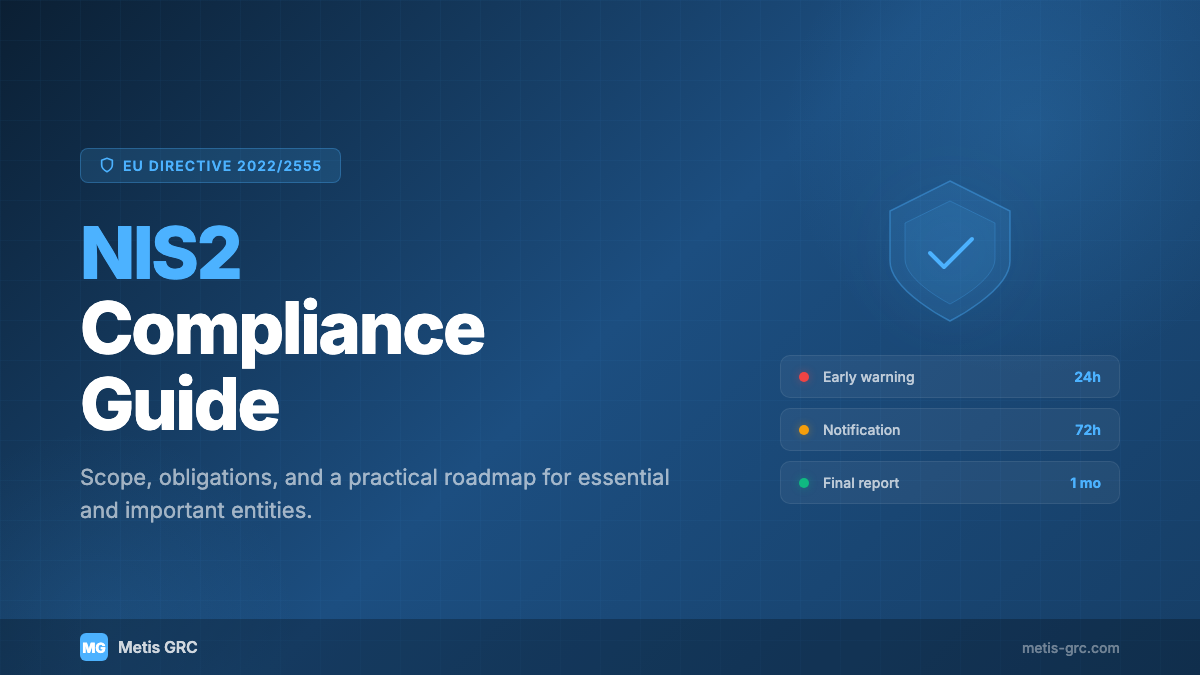
Part 2 of 2 — Roadmap, evidence, and how to make compliance operational.
Part 1 covered the essentials: who is in scope and what NIS2 requires. Part 2 focuses on execution—how to build a compliance roadmap that is realistic under operational constraints and credible under supervisory scrutiny.
If you remember one principle: NIS2 is evaluated through evidence. You don’t “comply” by declaring intent. You comply by demonstrating governance, controls, and repeatable outcomes.
Enforcement reality: treat this like a board-level risk
Essential vs Important: the difference is scrutiny, not expectations
In practice:
- Essential entities should expect a higher likelihood of proactive oversight (audits, inspections, supervisory measures).
- Important entities often face more ex post supervision, but incidents and complaints can trigger scrutiny quickly.
Practical takeaway: build one program standard internally. Use category mainly to calibrate the intensity of audit readiness and external reporting.
Fines and sanctions: why leadership attention changes
NIS2 is designed to create executive accountability. Member States implement sanctions in national law, but the directive establishes meaningful consequences and supervisory powers.
Practical takeaway: the “security budget conversation” changes when resilience is tied to legal exposure and service continuity expectations.
A pragmatic NIS2 compliance roadmap
Most organizations fail NIS2 not because they lack security tools—but because they lack operating discipline: governance, ownership, evidence, and repeatability.
Use a phased approach that delivers measurable risk reduction early and builds a defensible compliance posture over time.
Phase 1 (Weeks 0–4): Scope, governance, and minimum viable compliance
Outcome: You can explain your NIS2 position in one page and show where evidence lives.
- Confirm scope and classification
- sector mapping and service footprint
- size thresholds + “regardless of size” exceptions
- identify competent authority/CSIRT and reporting route(s)
- Establish governance
- management sponsor and decision rights
- named NIS2 program owner and deputies
- risk acceptance model (who can accept what, and how)
- Stand up the evidence backbone
- policy register with version control
- risk register mapped to NIS2 requirements
- initial gap assessment with owners and deadlines
- documentation architecture (where evidence is stored and how it is retrieved)
- Incident reporting readiness
- a 24/72/1-month reporting workflow
- severity classification criteria
- contact lists (internal and external)
- templates: early warning, notification, final report
- a tested “declare incident” escalation path
Fast win: run a 2-hour tabletop focused purely on timelines and decision-making. If it’s messy in rehearsal, it will break in a real incident.
Phase 2 (Days 30–90): Controls that reduce operational risk quickly
Outcome: Your organization can prevent common failures, detect incidents faster, and recover more reliably.
Prioritize controls that address systemic outage risk and reporting reliability:
- Asset and service inventory
- business services and supporting systems
- external dependencies (SaaS, cloud, MSPs, telecoms)
- ownership (business + technical)
- Identity hardening
- privileged access management (even if incremental)
- MFA/strong auth for critical systems
- joiner/mover/leaver discipline
- admin segmentation (separate admin accounts, tiering)
- Backup and recovery that actually works
- immutable/offline backup options where feasible
- restore testing cadence with documented results
- ransomware-focused recovery playbooks
- Logging and detection aligned to services
- define “must-have” telemetry per critical service
- detection coverage mapped to top incident scenarios
- escalation routes to an on-call response function
- Vulnerability management tied to criticality
- patch SLAs by asset criticality and exposure
- exception process with expiry and risk acceptance
- vulnerability backlog reporting with trend metrics
- Supply chain controls for critical suppliers
- supplier tiering (critical / high / standard)
- baseline security requirements + right-to-audit language
- incident notification obligations and cooperation clauses
- continuous monitoring where justified (especially MSPs)
Phase 3 (Months 3–12): Resilience maturity and supervisory readiness
Outcome: Your program can withstand scrutiny and scale without heroics.
- Exercises that reflect reality
- multi-team incident simulations (IT, OT, legal, comms, exec)
- supplier-led incident scenarios (your vendor is the entry point)
- cross-border/operational disruption scenarios where relevant
- Assurance and testing
- internal audits with evidence sampling
- independent testing (e.g., pen tests) where appropriate
- remediation tracking with deadlines and ownership
- Secure development and change controls (where relevant)
- vulnerability handling and disclosure process
- secure configuration baselines
- change management tied to service risk
- Board-ready metrics Move beyond “number of incidents.” Focus on outcomes:
- time to detect, time to contain, time to recover
- backup restore success rate and RTO achievement
- exposure windows for critical vulnerabilities
- third-party risk concentration and critical supplier posture
- compliance evidence completeness (control-by-control)
The “evidence pack” supervisors expect
If asked tomorrow, you should be able to produce:
Governance
- management oversight records (minutes, decisions, training)
- cyber risk policy set and approval trail
- roles and responsibilities (RACI)
Risk management measures
- risk assessment methodology and current risk register
- policies and standards mapped to NIS2 requirements
- technical baseline evidence (IAM, logging, backup, patching)
Incident reporting
- incident management policy and playbooks
- reporting templates and escalation evidence
- incident logs demonstrating classification and timelines
Business continuity
- DR and backup strategy
- test results and remediation actions
- crisis management process and communications plan
Supply chain
- critical supplier list with tiering rationale
- contractual security clauses and SLAs
- monitoring approach and supplier incident coordination process
Assurance
- audit reports, tests, and improvement plans
- evidence of effectiveness testing (exercises, reviews)
Practical takeaway: evidence is not a document dump. It should be organized, current, and retrievable in hours—not days.
Common pitfalls (and how to avoid them)
- Policy-heavy, evidence-light
- Fix: map every policy to proof of implementation (logs, tickets, tests, training records).
- Incident timelines that assume perfection
- Fix: rehearse the 24-hour “early warning” process; simplify decision rights.
- Supply chain treated as procurement paperwork
- Fix: tier suppliers; focus on critical outsourcers; require incident cooperation clauses.
- No consistent risk acceptance model
- Fix: define thresholds, expiry dates for exceptions, and a board-level escalation rule.
- Metrics that don’t reflect resilience
- Fix: report recovery readiness, detection coverage, exposure windows, and supplier concentration—metrics leaders can act on.
Closing: treat NIS2 as a resilience upgrade, not a compliance sprint
The most successful NIS2 programs use the directive as leverage to secure what security leaders have long wanted: consistent governance, real recovery capability, and enforceable supplier accountability.
Compliance is the floor. Operational resilience is the goal.
Disclaimer: This article is informational and not legal advice. Align your program with your national transposition law and competent authority guidance.
References
- NIS2 Directive — European Commission — Official policy overview, scope, and implementation timeline.
- Directive (EU) 2022/2555 — EUR-Lex — Full legal text of the NIS2 Directive.
- NIS2 Directive FAQs — European Commission — Frequently asked questions on scope, obligations, and transposition.
- Implementing Regulation (EU) 2024/2690 — EUR-Lex — Technical and methodological requirements for digital infrastructure providers.
- ENISA Threat Landscape — Annual threat reports from the EU Agency for Cybersecurity.
Ready to assess your NIS2 applicability? Start with Metis GRC.